The official export channel of Fedar printers.
For any printer sold under Fedar brand from other China regions,we do not provide relevant after-sales service!
Fashion Clothing Sublimation Printing: Polyester Blends and Equipment
Sublimation Printing for Fashion Clothing
Sublimation prints on polyester, and fashion is where that limit gets tested hardest. Chiffon, georgette, crepe and poly-satin all take disperse dye well; a 100 percent polyester satin holds a deep black that surface printing cannot reach. But a 65/35 poly-cotton blouse will read two shades lighter than the same artwork on polyester, and a wool blend will not take colour at all. Ask for the fibre content of every colourway before quoting, not just the first one. Weight changes the settings more than colour does. Light cloth at 60 to 90 gsm, meaning chiffon, georgette or light crepe, needs a lower calender temperature and a shorter dwell than 150 gsm scuba or ottoman, or the panel shrinks along the weft and the grain goes out of line. Satin needs the same care for a different reason: excess heat flattens the sheen, and a dress that should catch light comes out matte across the chest panel. Then there is repeat versus placement. An allover print is a roll job, and its repeat has to match at the seam. A placement print on a bodice is a panel job and needs the pattern block, not the repeat. Colour approval is the other half of the job. A buyer approves a lab dip, not a file, so keep a printed reference swatch for every colourway and record the profile it was printed with. Two months later, when the repeat order lands, that swatch is the only thing that gets you back to the same shade.

From Strike-Off to Finished Garment
Fashion runs are short, so the cost of a wrong first panel is high. Four steps keep the result predictable. Strike-off. Print the actual fabric at the actual weight before the bulk run. A strike-off on 120 gsm poly-cotton tells you nothing about how 70 gsm chiffon will behave. File preparation. Allover repeats need the repeat measured and matched at the seam; placement prints need the pattern block with registration marks, not a scaled image. Transfer. On light cloth, lower temperature with a longer dwell is safer than the reverse. Feed paper and fabric together under even tension, because chiffon ruffles the moment one selvedge runs faster than the other. Finishing. Let panels cool flat, then steam rather than press. A hot iron on sublimated satin brings the sheen back patchily and leaves a visible plate mark. Two faults recur. Ghosting is a second impression from a panel that shifted during transfer, usually because the paper was still damp. Creasing comes from cloth folded while warm, and it takes a permanent line that no amount of steaming removes.
From Strike-Off to Finished Garment
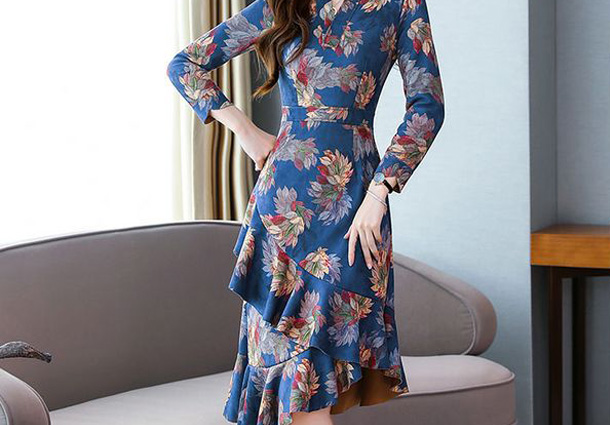
Dresses
Dresses
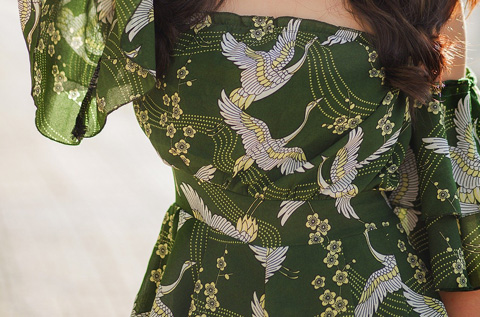
Blouses
Blouses
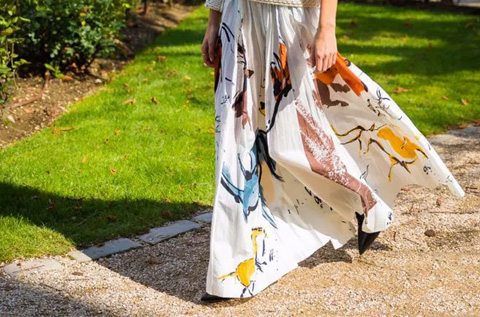
Scarves
Scarves
Co-ord Set
Co-ord Set
Which Machine Fits a Short-Run Collection
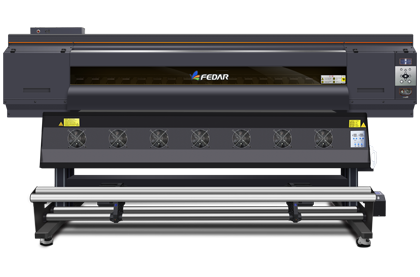
Fashion orders arrive as many designs at low metreage, so changeover speed matters more than top speed. Sampling and small studios: a 1.9 m three-head machine (FD5193E) prints a strike-off in minutes and runs 120 square metres an hour at two-pass once an order confirms. Mixed quality within one collection: the FD6194E holds 180 square metres an hour at two-pass, 120 at three-pass and 90 at four-pass. That range matters when a range combines photographic prints with fine line work. Volume basics and multi-season programmes: the FD6198E reaches 370 square metres an hour. Wide panels and home-textile crossover: 3.2 m (FD5328E) removes the seam on a full-width placement print. Two practical checks. First, how many designs you run a week, not how many metres: a machine that changes paper and profile in ten minutes beats a faster one that needs an hour. Second, whether your finishing is steaming or pressing, because satin and crepe punish pressing far more than polyester jersey does. Paper follows the cloth: 90 to 100 gsm for most apparel, lighter stock for chiffon where heavy paper marks the surface. If most of your output is under 300 metres a design, a 1.9 m machine is the right size. A 3.2 m unit earns its floor space only on continuous work or full-width placements.
+
More Related Products